Designing with Bunting Flag Templates for Instant Celebratory Impact
When you are tasked with creating a party atmosphere in a design file, standard geometric shapes often fall flat. There is a specific visual language required to convey "celebration," and that language is usually found in the details of event decor. This is where Bunting Flag Templates come into play, offering a ready-made solution for designers who need that festive aesthetic without the hassle of manual vector tracing. These assets are not just random shapes; they are curated design elements built to bring structure and joy to your projects.
Visual Characteristics and Style
The core appeal of these templates lies in their versatility within the "festive" niche. Bunting, by nature, is repetitive and rhythmic, creating a sense of flow and movement across a page or screen. The visual personality of these flags is inherently playful yet structured. Unlike a chaotic splatter or a grunge texture, bunting provides a clean, orderly way to add color and excitement. The style sits comfortably between retro charm and modern minimalism, depending entirely on the color palette you apply to the vector shapes.
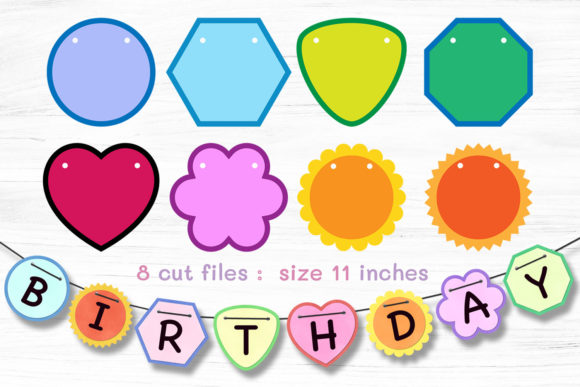
Because these are digital files rather than a static typeface, they function more like a modular design system. You are essentially working with a creative font of shapes. The visual consistency across the 16 different designs ensures that whether you choose a scalloped edge, a pointed pennant, or a rectangular flag, the "weight" and presence of the element remain balanced. This balance is crucial for maintaining a professional look in brand identity systems that rely on recurring motifs.
Practical Applications in Modern Design
For the small business owner or entrepreneur, these templates solve a very specific problem: how to make a digital storefront feel like a physical celebration. In web design, these assets work beautifully as decorative dividers between sections on a landing page, or as part of a "Grand Opening" banner. They are particularly effective in packaging design for artisanal goods, where a hand-crafted feel is part of the brand perception. Imagine a coffee bag or a candle label where the "Best Seller" tag is accentuated by a subtle bunting motif; it immediately signals care and attention to detail.
For marketers and content creators, the utility extends heavily into social media graphics. Instagram stories, Pinterest pins, and Facebook headers often require visual shorthand to grab attention. A row of colorful flags instantly communicates a sale, a giveaway, or a holiday greeting. Because the templates include individual SVG files and PNG files, they are drag-and-drop ready for most major design software, allowing for rapid prototyping and publishing.
Even in editorial design, such as magazines or bloggers creating header images, bunting can be used to create visual hierarchy. By placing the flags above a headline, you draw the reader's eye to the title. It acts as a visual cue that says, "This section is important and celebratory." The ability to resize the 10"-12" digital files means you can scale them up for a full-page bleed or shrink them down for a subtle footnote decoration without losing quality, thanks to the vector nature of the DXF and EPS formats.
Integrating Assets for Maximum Readability
One of the common pitfalls in using decorative elements is compromising readability. However, because bunting is typically used as a background layer or a framing device, it actually supports modern typography rather than hindering it. The key is to treat these templates as a serif font or sans serif font would be treated—by ensuring there is enough contrast and whitespace.
When pairing these flags with text, consider the mood you are setting. If your project requires a whimsical, organic feel, pair the bunting with a script font or a handwritten font. The curves of the flags will complement the loops of the lettering. Conversely, if you are aiming for a clean, corporate event look—perhaps for a conference or a gala invite—pairing the sharp edges of rectangular bunting with a geometric sans serif font creates a sophisticated, high-end aesthetic.
The consistency of the asset files is a major advantage for brand recognition. By using the same set of 16 designs across your print and digital materials, you reinforce your visual identity. The fact that the package includes a single SVG file containing all 16 designs allows for complex compositions where you might want to mix and match different flag styles to create a longer, more dynamic garland.
Technical Flexibility and Workflow
From a workflow perspective, the inclusion of multiple file formats demonstrates an understanding of professional needs. The SVG and EPS formats are the workhorses for professional designers using Adobe Illustrator or Affinity Designer, ensuring that the lines remain crisp regardless of the final output size. The DXF files are particularly valuable for those in the maker space, such as crafters using cutting machines like Cricut or Silhouette. This allows the digital templates to become physical objects—paper bunting for a photoshoot backdrop or vinyl decals for shop windows.
For the publisher or designer concerned with licensing, it is important to note that these are premium font style assets. Treating them as commercial font equivalents means checking the usage rights, but the value they provide in saving design time is substantial. Instead of drawing bezier curves for individual pennants, you can focus on the color theory and layout strategy.
Ultimately, Bunting Flag Templates are more than just "party decorations." They are a versatile set of design assets that can inject energy, guide the viewer's eye, and unify a campaign across various media. Whether you are a hobbyist scrapbooking a family memory or a brand strategist